
Related Articles
As businesses grow, financial complexity increases. Revenue expands, teams scale, compliance becomes tighter, and decision making requires deeper financial insight. At this stage, founders often face a critical question. Should they hire a full time CFO or engage a Virtual CFO?
The answer is not only about cost. It is about value, flexibility, and return on investment. Both models offer leadership, but they operate differently in structure, engagement, and financial impact.
This article compares Virtual CFO and full time CFO models across role, cost, flexibility, and ROI so growing businesses can make an informed decision.
Understanding the Role of a CFO
Strategic leadership vs operational execution
At the core, a CFO provides financial direction. This includes capital allocation, cash flow strategy, profitability analysis, forecasting, and long term planning. The CFO aligns finance with business goals and ensures that growth is sustainable.
Operational finance, such as bookkeeping, compliance filing, and transaction recording, is important. But the real value of a CFO lies in strategic oversight. A strong CFO transforms financial data into business insight.
Both a Virtual CFO and a full time CFO perform this strategic function. The difference lies in engagement structure and cost efficiency, not in the level of financial thinking they bring to the table.
Decision-making authority and accountability
A CFO is part of the leadership team. They influence pricing decisions, expansion plans, hiring strategy, funding rounds, and risk management. Their authority comes from their accountability to financial performance.
In a traditional setup, a full time CFO is embedded within the organization. In a modern structure, a Virtual CFO provides the same decision support but operates on an engagement model rather than payroll.
In both cases, the role of the CFO remains consistent. The distinction is how that expertise is accessed and structured.
Role Comparison of Virtual CFO vs Full Time CFO
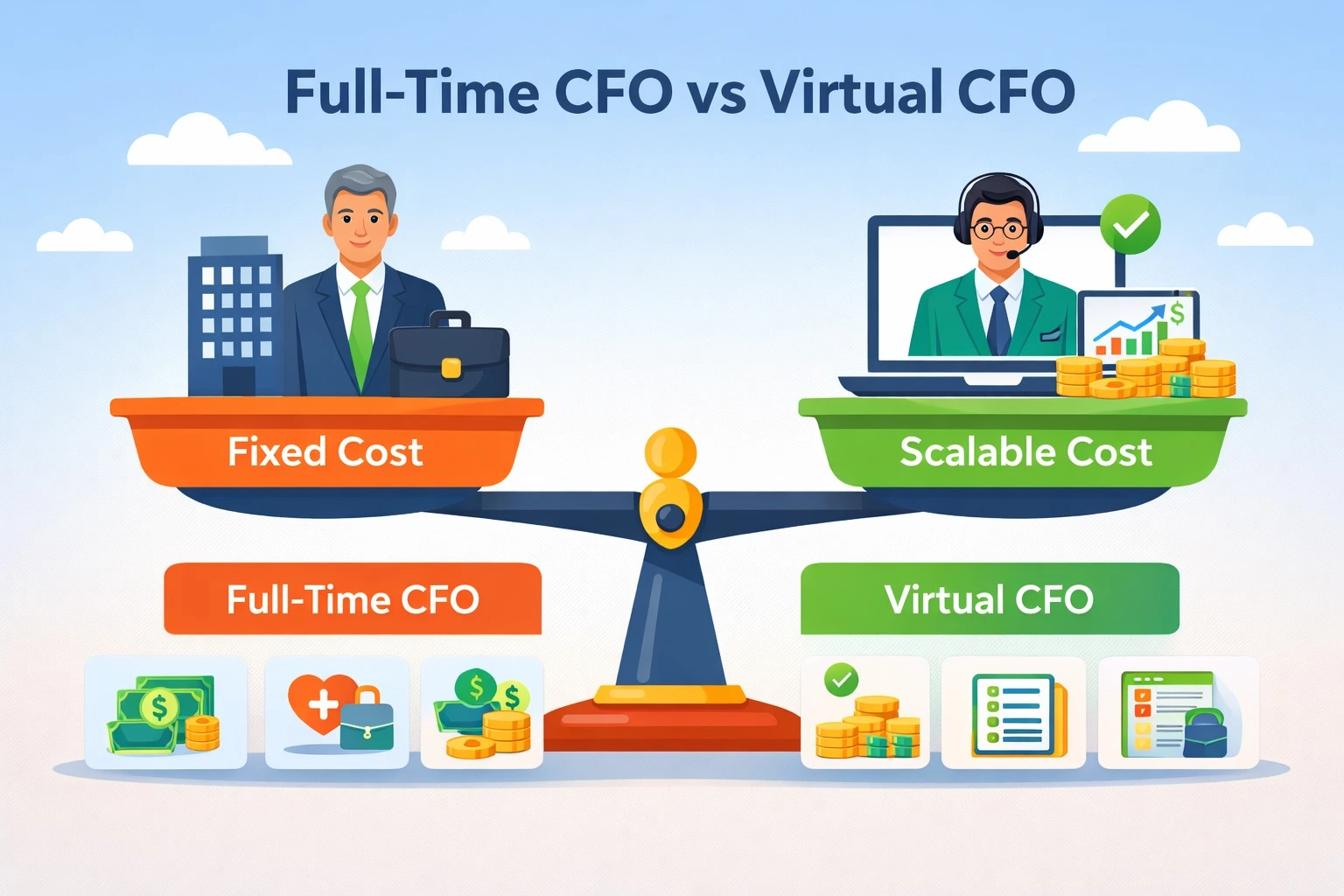
Scope of work and responsibilities
A full time CFO is responsible for end to end financial leadership. This may include managing the finance team, overseeing audits, dealing with investors, and driving internal financial governance.
A Virtual CFO provides similar CFO services but in a structured engagement model. The scope typically includes financial planning, budgeting, cash flow management, MIS reporting, risk assessment, compliance oversight, and board level reporting.
For most growing businesses, the responsibilities of a Virtual CFO align with their needs without requiring a permanent executive hire.
Level of strategic involvement
Strategic involvement depends more on the agreement than on employment type. A high quality Virtual CFO can be deeply involved in financial modeling, fundraising preparation, and profitability improvement.
A full time CFO may have broader daily interaction with internal teams. However, many businesses do not require full day financial leadership. They require focused strategic input, structured reporting, and disciplined execution.
In such cases, a Virtual CFO delivers comparable strategic value without the overhead of a full time role.
Availability and engagement model
A full time CFO is physically present and available during business hours. This suits enterprises with large internal finance departments or complex daily financial operations.
A Virtual CFO operates on a predefined engagement structure. This may include weekly review meetings, monthly reporting, and quarterly strategic planning sessions. The model is outcome driven rather than time driven.
For many startups and mid-sized companies, this structured availability is sufficient and efficient.
Industry and functional expertise
When hiring a full time CFO, expertise depends on the individual candidate. Replacing or upgrading talent requires another hiring cycle.
Virtual CFO services often provide access to broader expertise. Many firms bring cross industry exposure, diverse financial systems experience, and specialized knowledge in compliance, automation, and scaling operations.
This breadth can be especially valuable for founders navigating rapid growth or industry transitions.
Cost Comparison of Virtual CFO vs Full Time CFO
Salary, benefits, and fixed costs of a full-time CFO
Hiring a full time CFO involves significant fixed costs. These include annual salary, bonuses, health benefits, retirement contributions, office infrastructure, and potential equity.
In addition, there are recruitment costs and the risk of a wrong hire. Once onboarded, the cost remains fixed regardless of how intensively the CFO is utilized.
For large enterprises, this investment may be justified. For growing businesses, it can strain cash flow.
Engagement-based pricing of Virtual CFO services
Virtual CFO services operate on a monthly or project based engagement. Pricing depends on scope, complexity, and reporting requirements.
Businesses pay for defined outcomes such as financial dashboards, forecasting models, board reports, compliance oversight, and performance reviews. This converts a fixed executive cost into a scalable operational expense.
This model allows access to experienced CFO leadership at a fraction of the cost of a full time executive.
Hidden costs of hiring and onboarding
Hiring a full time CFO involves more than salary. Time spent interviewing, onboarding, aligning systems, and integrating leadership into culture carries indirect cost.
There is also risk. If performance does not meet expectations, replacement is expensive and disruptive.
With a Virtual CFO, onboarding is typically structured. Systems, reporting frameworks, and processes are implemented as part of the engagement. The model reduces long term hiring risk.
Cost scalability as the business grows
A full time CFO cost remains constant. It does not scale down during slow periods.
A Virtual CFO engagement can be expanded during fundraising, acquisitions, or rapid growth. It can also be optimized during stable or slower periods.
This cost flexibility is a significant advantage for businesses with variable growth patterns.
Flexibility and Scalability of CFO Models
Scaling finance support up or down
As companies grow, financial complexity increases. During early stages, founders need structured financial reporting and cash discipline. During growth stages, they require scenario modeling and investor reporting.
A Virtual CFO can scale involvement based on need. Engagement hours, reporting depth, and strategic sessions can be adjusted.
A full time CFO offers continuity but less structural flexibility in cost.
Adapting CFO involvement to business stages
In early stages, businesses need financial clarity and compliance structure. During expansion, they need growth strategy, pricing optimization, and capital planning. At scale, they require governance, investor management, and risk mitigation.
Virtual CFO services are particularly effective for early and growth stages where the need for expertise is high but full time executive cost is difficult to justify.
For mature enterprises with large finance teams, a full time CFO may be more appropriate.
Flexibility during growth, slowdown, or pivots
Business conditions change. Markets shift. Revenue fluctuates. Strategy pivots happen.
A Virtual CFO model provides flexibility during uncertain periods. Engagement can be adjusted while maintaining financial oversight.
A full time CFO provides stability but adds fixed cost pressure during downturns.
ROI Comparison for Growing Businesses
Speed of impact on financial clarity
A structured Virtual CFO engagement often begins with financial diagnostics. Reporting systems are cleaned up, dashboards are implemented, and cash flow visibility improves quickly.
This rapid clarity allows founders to make informed decisions.
A full time CFO may take longer to recruit and onboard. Impact begins after integration into systems and teams.
Value delivered vs cost incurred
When evaluating ROI, consider profit improvement, cost optimization, working capital efficiency, and risk reduction.
If a Virtual CFO improves margins, reduces unnecessary expenses, and strengthens cash management, the ROI can significantly exceed engagement cost.
A full time CFO may deliver similar value but at a higher fixed cost. The return must justify the compensation package.
ROI at early, growth, and scale stages
At early stage, ROI from a Virtual CFO is often highest because structured financial control prevents costly mistakes.
At growth stage, strategic forecasting and pricing discipline directly impact profitability and investor confidence.
At scale stage, the decision depends on operational complexity. Large enterprises with global operations may justify a full time CFO. Mid sized businesses often continue benefiting from structured CFO services without full executive overhead.
Conclusion: Choosing the Right CFO Model for Your Business
The comparison between Virtual CFO and full time CFO is not about which role is superior. It is about alignment with business stage, complexity, and financial capacity.
A full time CFO offers embedded leadership and constant availability. This suits large enterprises with high financial complexity.
A Virtual CFO offers strategic financial leadership, structured reporting, and cost efficiency. For startups and growing businesses, this model delivers strong ROI without heavy fixed expense.
If your business needs financial clarity, disciplined forecasting, improved cash flow management, and strategic guidance, exploring Virtual CFO services may be the most practical and high return decision you can make.
Now is the time to evaluate whether your current finance structure supports your growth ambitions.
Connect with an experienced Virtual CFO team and discover how strategic CFO services can strengthen your financial foundation and accelerate sustainable growth.
Share
Trending Topics
-
 March 28, 2026
 -
 March 10, 2026
 -
 March 03, 2026
 -
 February 24, 2026
 -
 February 18, 2026
 -
 February 12, 2026
 -
 November 19, 2025
What Can Virtual CFO Services Really Do for Your Growing Business
-
 November 17, 2025
Why Is Financial Automation the Secret Weapon for Modern SMEs
-
 November 12, 2025
Can Virtual CFO Services Help You Build Investor Trust Before an IPO
-
 November 11, 2025
How to Automate Your Business to Make It IPO Ready with a Virtual CFO
-
 September 10, 2025
How Can Virtual CFO Services Transform Your Business Finances
-
 September 22, 2025
How Can Businesses Streamline Their Finance Processes for Better Growth
-
 October 14, 2025
How CFO Services Help Startups Navigate Compliance and Taxation
-
 October 07, 2025
Avinit Gupta
A sharp, execution-driven Chartered Accountant delivering precision-led finance, compliance excellence, and scalable growth clarity for modern businesses.