
RBI Rate Hike: What It Means for Business Loans Before the December MPC
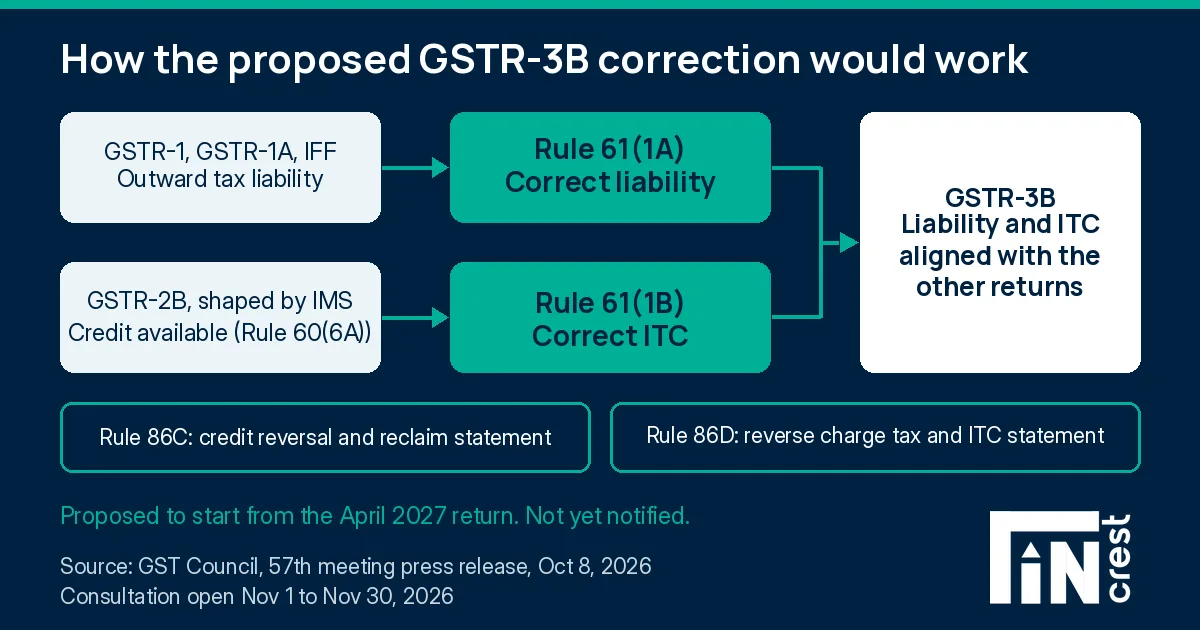
GSTR-3B correction is a proposed facility that would let a business fix its tax liability and input tax credit (ITC) inside the GST return process, so that GSTR-3B matches GSTR-1 and GSTR-2B (the auto-generated ITC statement). The GST Council recommended it at its 57th meeting on October 8, 2026, and suggested that it apply from the return for April 2027. It has not been notified, so it is not law yet. Until the rules are notified, today's rules apply, including the notices that follow a mismatch.
Here is what the Council proposed and what a finance team can do before April 2027. The dates and rules below come from the official press release and the CBIC consultation notice, which TaxGuru reproduces. The practical reading draws on the practitioner analyses linked in the text.
In this guide
- What is GSTR-3B correction?
- Which rules are proposed?
- When will GSTR-3B correction start?
- Why does IMS matter for GSTR-3B correction?
- What will not change?
- What should finance teams do before April 2027?
- How can automation and FinCrest help?
- Frequently asked questions
Key takeaways
- Still a proposal. The Council recommended GSTR-3B correction on October 8, 2026.
- Two core rules. Rule 61(1A) would align liability in GSTR-3B with GSTR-1, GSTR-1A and IFF. Rule 61(1B) would align ITC with GSTR-2B.
- Suggested start. The return for April 2027, after a public consultation that runs from November 1 to November 30, 2026.
- IMS would get a legal footing. Proposed Rule 60(6A) would give accept, reject and pending actions a legal framework.
- What to do now. Reconcile monthly, keep clean reversal and reverse charge registers, and set an internal IMS policy.
Want a second pair of eyes on your GST reconciliation? Book a free consultation with FinCrest.
What is GSTR-3B correction?
GSTR-3B is the summary return in which a business reports its tax liability, claims ITC and pays tax. Today, a filed GSTR-3B cannot be revised. A practitioner analysis on CAclubindia describes the result: the mistake gets pushed into a later month, explained in the annual return, or ends up as a system notice.
The 57th meeting of the GST Council proposed a way around this. Its press release, also published by the Press Information Bureau, recommends an alternate mechanism for amending liability and ITC in the GST return, so that mismatches and the notices that follow them fall.
In plain terms, GSTR-3B correction would let a taxpayer fix reported liability and credit in a structured way. A TaxGuru weekly roundup of the consultation says liability corrections would be routed through GSTR-1, GSTR-1A or IFF, rather than by editing auto-populated values in GSTR-3B.
Which rules are proposed?
The press release lists several linked measures.
| Proposed rule or form | What it would do | Why finance teams should care |
|---|---|---|
| Rule 61(1A) | Provides a mechanism to report and correct liability so that GSTR-3B aligns with GSTR-1, GSTR-1A and the Invoice Furnishing Facility (IFF). | Targets outward-side mismatches that raise system notices. |
| Rule 61(1B) | Provides a mechanism to report and correct ITC so that GSTR-3B aligns with GSTR-2B. | Credit claimed in GSTR-3B would need to align with the credit shown in GSTR-2B. |
| Rule 60(6A) | Gives the Invoice Management System (IMS) a legal basis for accept, reject or pending actions, with a limit on how long a credit note can stay pending. | Your IMS choices shape the ITC shown in GSTR-2B. |
| Rule 86C | Provides in the rules for the Electronic Credit Reversal and Reclaim Statement on the portal. | ITC reversals and reclaims need a clean record. |
| Rule 86D | Provides in the rules for the Electronic Statement of tax paid on reverse charge basis and ITC claimed. | Reverse charge tax and its credit must tie out. |
| FORM GST DRC-03 | Amended so that a payment declares the underlying invoice. | Payments made through DRC-03 would need invoice-level detail. |
The release also recommends enhancements to GSTR-1, GSTR-1A and IFF to ease reconciliation with GSTR-3B, and a circular that explains how to report ITC and its reversal in GSTR-3B.
When will GSTR-3B correction start?
The Council recommended that the mechanism come into force from the return for April 2027. That date is a target and still depends on consultation, rule amendments and notification. TaxGuru's analysis of the release says taxpayers should keep applying the law currently in force and should not change return positions or claim additional credits only because of the announcement.
The proposal also goes through a consultation first. The Central Board of Indirect Taxes and Customs (CBIC) opened a consultation on the proposed mechanism that runs from November 1 to November 30, 2026, for taxpayers, tax practitioners and industry associations. The press release adds that the Union Finance Minister is authorized to approve changes based on the feedback. The final rules may therefore differ from today's description.
Two details of the consultation matter if you plan to comment. Participation is voluntary, and once a suggestion for an area is submitted it cannot be edited. Draft your comment in full before you submit it.
Why does IMS matter for GSTR-3B correction?
The Invoice Management System, or IMS, is the portal facility where a recipient accepts, rejects or keeps pending the inward documents that suppliers report. Those actions feed the ITC statement in GSTR-2B. Proposed Rule 60(6A) would give this facility a legal framework, including a limit on how long a credit note can stay pending.
That matters because proposed Rule 61(1B) ties ITC in GSTR-3B to GSTR-2B. The CAclubindia analysis argues that once IMS actions carry a legal framework, they will shape the credit available and become the reference point for any ITC correction. It warns that a business that leaves IMS unattended could see its available credit determined by default.
What will not change?
A correction facility would reduce mismatches, but it would not remove the duty to report tax correctly in the first place. The CAclubindia analysis notes that interest and other consequences of the underlying error may still apply, and that the final rules will decide how they are handled.
Current obligations also continue. The October 8 press release records recommendations only, and TaxGuru's analysis adds that existing filing, payment and record-keeping obligations continue until the law changes.
What should finance teams do before April 2027?
You do not need to wait for the notification to build the habits the proposal assumes. The steps below are adapted from the CAclubindia analysis. The month-end sequencing is our own suggestion.
- Reconcile GSTR-1 with GSTR-3B every month. Differences are easier to explain in the month they arise, so compare by tax head and period.
- Reconcile books, GSTR-2B and GSTR-3B ITC at invoice level. Make it a monthly routine.
- Keep a register of ITC reversals and reclaims. Record the reason and the period for each, because proposed Rule 86C would give that statement a basis in the rules.
- Keep a reverse charge register. Match tax paid under reverse charge with the credit claimed, so the proposed Rule 86D statement has a clean base.
- Write an IMS policy. Decide who accepts, rejects or keeps invoices pending, and by which date in the month.
- Follow the draft rules and circular. If the draft raises a practical issue, send comments through your trade body or professional association.
- Brief your leadership team. Tell them that current rules still apply and that the proposal does not relax the need to report accurately.
Put the first two checks into the month-end close calendar, ahead of the GSTR-3B filing date. A difference caught before filing can be fixed in the books; after filing it can lead to a notice.
How can automation and FinCrest help?
The CAclubindia analysis reads the proposal as a push toward continuous reconciliation. Teams that already tie their sales and purchase registers to their GST returns every month would have little to change. Teams that reconcile only at year end would face a backlog first.
It adds that reconciliation software suits this work, because it matches at invoice level, flags the cause of each difference and keeps a trail of reversals, reclaims and reverse charge entries. The judgment calls stay with your finance lead: which differences to correct, and how to document them. Our guides on automating financial reporting for operational efficiency and financial automation for modern SMEs cover how to build that foundation.
FinCrest's Business Finance and Compliance service covers clean books, reconciliations, GST, TDS, ROC filings and MIS reports for SMEs. If you want a monthly GST reconciliation routine in place before the new rules arrive, our team can set it up with you.
Frequently asked questions
What is GSTR-3B correction?
GSTR-3B correction is a proposed facility that would let taxpayers correct liability and input tax credit within the return process. Under proposed Rules 61(1A) and 61(1B), GSTR-3B would be aligned with GSTR-1, GSTR-1A, IFF and GSTR-2B. The GST Council recommended it on October 8, 2026. It is not yet in force.
When will the GSTR-3B correction facility start?
The GST Council recommended that it come into force from the return for April 2027. That date is only a target. The mechanism first goes through public consultation, which runs from November 1 to November 30, 2026, and still needs formal rule amendments and portal changes before it applies.
Can I rely on the proposed correction facility in my current return?
No. A Council recommendation does not change the law. Until the rules are notified and take effect, file GSTR-3B under the rules that apply today and keep your reconciliations current. The announcement alone is not a basis for changing a return position or claiming additional credit. Read the final notification before you act.
What is the Invoice Management System (IMS) and why does it matter?
IMS is the portal facility where a recipient accepts, rejects or keeps pending the inward documents reported by suppliers. Those choices feed the ITC statement in GSTR-2B. Proposed Rule 60(6A) would give IMS a legal framework, including a limit on how long a credit note can stay pending.
Who can comment on the proposal, and by when?
CBIC invited taxpayers, tax practitioners, industry associations and other stakeholders to share suggestions between November 1 and November 30, 2026. Participation is voluntary, and once a suggestion for an area is submitted it cannot be edited, so prepare your comment fully before you submit it.
Related reading
- How CFO services help startups navigate compliance and taxation
- Direct tax amendments 2025
- What virtual CFO services can do for a growing business
This article is for general information and is not tax advice. Check the final notification before acting on any proposal.
Share
Trending Topics
-
 November 20, 2026
-
 November 15, 2026
GSTR-3B Correction: What the Proposed Rules Mean for Finance Teams
-
 March 28, 2026
-
 March 10, 2026
-
 March 03, 2026
-
 February 24, 2026
-
 February 18, 2026
-
 February 12, 2026
-
 November 19, 2025
What Can Virtual CFO Services Really Do for Your Growing Business
-
 November 17, 2025
Why Is Financial Automation the Secret Weapon for Modern SMEs
-
 November 12, 2025
Can Virtual CFO Services Help You Build Investor Trust Before an IPO
-
 November 11, 2025
How to Automate Your Business to Make It IPO Ready with a Virtual CFO
-
 September 10, 2025
How Can Virtual CFO Services Transform Your Business Finances
-
 September 22, 2025
How Can Businesses Streamline Their Finance Processes for Better Growth
-
 October 14, 2025
How CFO Services Help Startups Navigate Compliance and Taxation
-
 October 07, 2025
Avinit Gupta
A sharp, execution-driven Chartered Accountant delivering precision-led finance, compliance excellence, and scalable growth clarity for modern businesses.