
RBI Rate Hike: What It Means for Business Loans Before the December MPC
The RBI rate hike of October 7, 2026 raised the repo rate by 25 basis points (bps) to 5.50%, and forecasters expect more at the next Monetary Policy Committee (MPC) meeting on December 2 to 4. A basis point is one hundredth of a percentage point. If your bank loan is linked to the repo rate or another external benchmark, the rate must reset at least once every three months. If it is linked to a bank's marginal cost of funds based lending rate (MCLR), it moves at your next reset date. Either way, borrowing costs are rising, so plan before December.
This guide covers what the Reserve Bank of India (RBI) did, why October inflation of 6.09% raised the odds of another hike, how fast a hike reaches your loan, and what a CFO or founder should do first. Facts come from RBI and MoSPI releases and the news reports linked in the text. Forecasts are named and are not certain, and the December decision has not been taken.
In this guide
- What did the RBI change in October 2026?
- Why did 6.09% inflation raise the odds of another RBI rate hike?
- How high could the repo rate go?
- How quickly does a repo rate hike reach your business loan interest rate?
- How much could a higher MSME loan interest rate cost a small business?
- What should CFOs and founders do before the December MPC?
- Should a growing business stop borrowing?
- Frequently asked questions
- Related reading
Key takeaways
- The repo rate is 5.50%. The RBI raised it by 25 bps on October 7, 2026, its first hike since February 2023, and moved to a stance of calibrated tightening.
- Inflation is above the ceiling. October retail inflation was 6.09%, above the top of the RBI's 2% to 6% tolerance band.
- Banks are already passing it on. Seven large banks raised their MCLR between October 15 and November 12, 2026.
- Forecasts differ. ICRA calls a 25 bps hike in December almost certain, SBI's chairman said in remarks reported on October 26, before the October inflation figure, that 50 bps is possible, and Goldman Sachs sees 6.25% by mid-2027.
- Act before December. Map every facility, stress test cash flow at 25, 50 and 75 bps, and check which loans you can prepay without charges.
Want a second pair of eyes on your loans and cash flow before the December MPC? Book a free consultation with FinCrest.
What did the RBI change in October 2026?
On October 7, 2026, the MPC voted unanimously to raise the policy repo rate by 25 bps to 5.50%, according to the RBI's policy statement. The standing deposit facility rate went to 5.25%, and the marginal standing facility rate and the Bank Rate to 5.75%. ETBFSI reports that it was the first increase since February 2023, after cuts that had taken the rate down to 5.25% by December 2025.
The committee also changed its stance to "calibrated tightening". Two of its six members preferred to keep a neutral stance. The RBI said the new stance means rate cuts are off the table in the near term, so the next move can only be a hike or a pause.
The RBI projects real GDP growth of 7.1% and consumer price inflation of 5.2% for 2026-27, with the October to December quarter at 6.0%. It named the West Asia conflict, volatile crude oil and a deficient south-west monsoon among the pressures.
Why did 6.09% inflation raise the odds of another RBI rate hike?
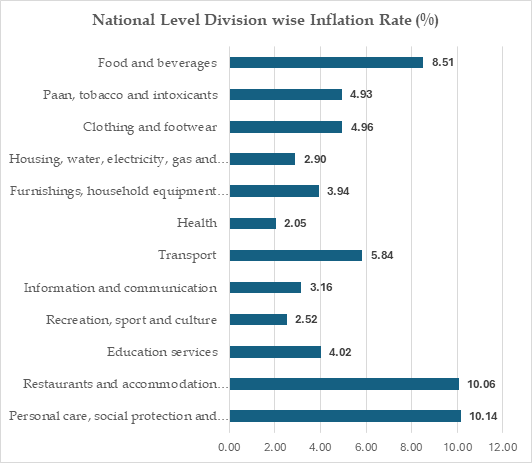
Image: PIB (MoSPI). Click to read the full report.
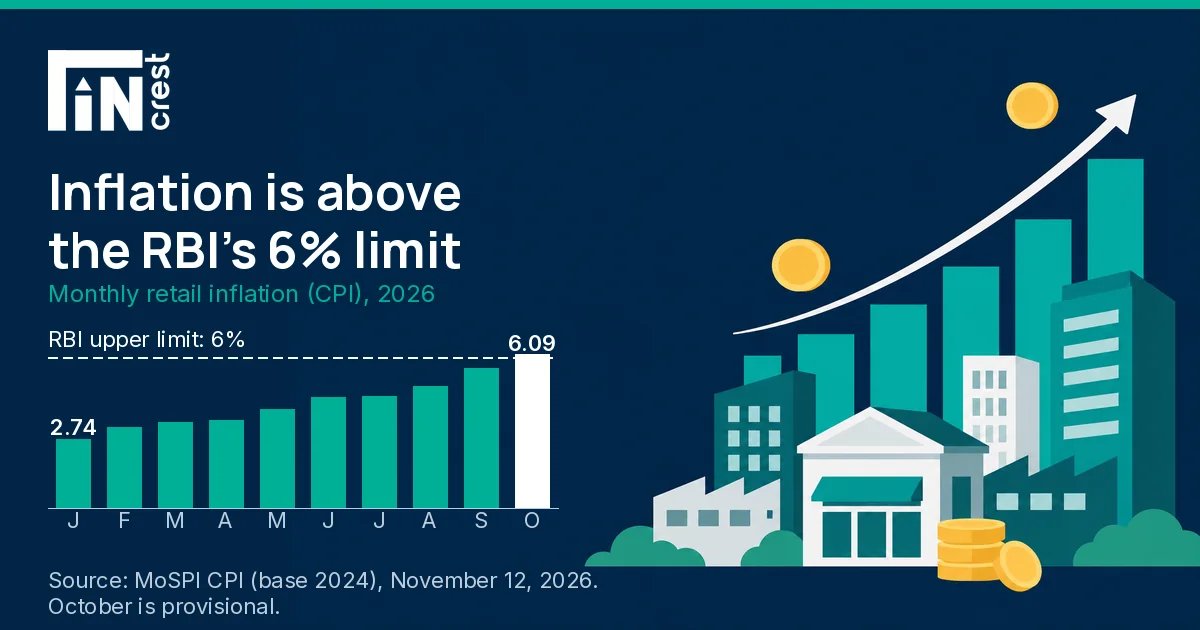
The release of the Ministry of Statistics and Programme Implementation (MoSPI) on November 12 put October retail inflation, measured by the Consumer Price Index (CPI), at 6.09% on a provisional basis. September was 5.54%. Food inflation was 8.94%. The rate has risen every month this year, from 2.74% in January to 4.38% in June and 5.54% in September.
Mint reported that this is the first reading above 6% since the new CPI series began in January 2026. Reuters added that 19 of 43 CPI sub-groups were at 4% or higher in October, against 14 in September, which points to broad price pressure.
The RBI's target is 4%, with a tolerance band of 2% to 6%. ThePrint explains that a formal failure to meet the target needs average inflation above 6% for three straight quarters, so one month above 6% is not a failure. It also notes that the month-on-month rise has slowed, from 1.03% in June to 0.51% in October.
How high could the repo rate go?

Image: Business Standard. Click to read the full report.
Nobody knows yet, and the named forecasts differ. None of the views below is an RBI decision.
- ICRA. ThePrint reported that chief economist Aditi Nayar said in a statement that a further 25 bps hike at the December meeting appears almost certain.
- DBS and PwC India. In the Mint report, DBS Bank's Radhika Rao expects a second straight hike in December. PwC India's Ranen Banerjee expects 25 to 50 bps.
- SBI. BusinessLine reported on October 26 that SBI chairman CS Setty said a 50 bps hike may come in December, followed by a pause until the end of March 2027. That was before the October inflation figure.
- Goldman Sachs. Business Standard reported on November 18 that Goldman sees 25 bps in December and 50 bps more in the first half of 2027, taking the repo rate to 6.25% by April to June 2027.
- Economists. Business Standard reported on November 16 that economists expect another 50 to 75 bps, with a peak of 6.00% to 6.25%.
The same Goldman outlook expects growth to ease to 7.2% in calendar 2027 from an estimated 7.9% in 2026, and headline inflation of 5.7% in 2027 against 4.6% in 2026. Treat the December call as an expectation: the decision will depend on data still to come, including November CPI on December 14.
How quickly does a repo rate hike reach your business loan interest rate?
It depends on what your loan rate is linked to. The RBI's Interest Rates on Advances Directions, 2025, which apply to commercial banks, require banks to link floating-rate loans to micro, small and medium enterprises (MSMEs) to an external benchmark. That benchmark can be the policy repo rate, the 3-month or 6-month Treasury bill yield published by Financial Benchmarks India (FBIL), or another FBIL benchmark. The rate must be reset at least once every three months. This is the external benchmark lending rate (EBLR) route, and a repo hike reaches it quickly.
Older loans can sit on MCLR, the internal cost of funds measure that each bank publishes. The same directions say banks review MCLR every month, that the reset period written into your contract is one year or less, and that existing MCLR loans continue until repayment or renewal, with eligible borrowers allowed to switch to an external benchmark. The spread above the benchmark that reflects your credit risk can change only when the lender's assessment of your credit changes substantially.
The pass-through has begun. ETBFSI tracked these MCLR increases after the October hike. How far each bank moves depends on its funding mix, liquidity, deposit costs and competition.
| Bank | MCLR increase | Effective from |
|---|---|---|
| State Bank of India | 15 bps (3-month to 3-year tenors) | October 15 |
| Punjab National Bank | 10 bps (all six tenors) | November 1 |
| Bank of India | 10 bps (select tenors) | November 1 |
| Indian Bank | 10 bps (all five tenors) | November 3 |
| HDFC Bank | 5 to 15 bps (all seven tenors) | November 7 |
| Canara Bank | 10 bps (all seven tenors) | November 12 |
| Bank of Baroda | 5 to 20 bps (select tenors) | November 12 |
Source: ETBFSI, November 11, 2026.
For scale, the RBI's rates page showed overnight MCLR across banks between 7.85% and 8.10% on November 18 and 19.
How much could a higher MSME loan interest rate cost a small business?
Simple arithmetic shows the exposure. The table below is our own illustration, not a sourced estimate. It assumes a limit that stays fully drawn for the whole year, a rate increase passed on one for one, and an unchanged spread.
| Rate increase | Extra yearly interest on Rs 1 crore | Extra yearly interest on Rs 10 crore |
|---|---|---|
| 25 bps | Rs 25,000 | Rs 2.5 lakh |
| 50 bps | Rs 50,000 | Rs 5 lakh |
| 75 bps | Rs 75,000 | Rs 7.5 lakh |
A business with several facilities adds these up. Lenders also watch the debt service coverage ratio (DSCR), which compares the cash a business generates with the interest and principal it owes. Higher interest lowers that ratio, so a business that already runs close to its lender's comfort level has less room.
What should CFOs and founders do before the December MPC?
The order below is our own suggestion.
- Map every facility. List the lender, limit, amount drawn, benchmark, spread and next reset date for each loan.
- Stress test cash flow. Apply the 25, 50 and 75 bps cases to your actual drawn balances and check the monthly cash buffer and DSCR under each.
- Ask lenders in writing. Ask for the benchmark, the spread, the reset date and whether the credit risk premium has changed. Under the RBI directions it can change only when your credit assessment changes substantially.
- Check pre-payment charges before using surplus cash. Under the RBI's pre-payment charges directions, floating-rate business loans to individuals and micro and small enterprises carry no pre-payment charge at commercial banks, for loans sanctioned or renewed from January 1, 2026. For small finance banks and some other lenders, the rule covers sanctions up to Rs 50 lakh. For cash credit and overdraft limits, the directions waive the charge if you tell the lender in advance that you will not renew and the facility is closed on its due date. Check your sanction letter, because older loans may differ.
- Shorten the cash conversion cycle. Faster collections and tighter inventory reduce the amount you need to borrow.
- Compare deposits with loan costs. ETBFSI reports that HDFC Bank raised some fixed deposit rates by up to 50 bps from November 4, Canara Bank by up to 15 bps from November 2 and ICICI Bank by 10 bps on select longer tenors from October 23. Compare what idle cash can earn with what your debt costs.
- Watch the calendar. The MPC meets December 2 to 4, and November CPI is due on December 14. The RBI's rates page showed the rupee at 93.3461 per US dollar on November 19, which matters if you import.
A virtual CFO can help with the first three steps, from the debt map to the lender questions. FinCrest's virtual CFO services include cash flow and working capital control.
Should a growing business stop borrowing?
Not as a rule. The RBI still projects growth of 7.1% for 2026-27, and Goldman Sachs expects 7.2% in calendar 2027. BusinessLine quotes SBI's chairman as saying that demand for credit from productive activity is unlikely to fall.
Borrow when a rupee borrowed earns more than its higher cost. A loan with a clear payback can still make sense at a higher rate. Keep a cash buffer as well: our guide on burn rate vs runway shows how to track months of cash left, and our piece on strategic financing for business growth in India covers how to match funding to purpose.
This post covers the position as of November 20, 2026. We will refresh it after the December 2 to 4 MPC meeting and the November CPI release on December 14.
Frequently asked questions
What is the current RBI repo rate?
The repo rate is 5.50%. The RBI's Monetary Policy Committee raised it by 25 basis points on October 7, 2026, and the vote was unanimous. The next scheduled MPC meeting is on December 2 to 4, 2026, when the committee will review the rate again. Check the RBI website for the latest figure.
Will my business loan EMI rise after an RBI rate hike?
It can. Floating-rate bank loans to MSMEs linked to an external benchmark such as the repo rate must reset at least once every three months. Loans linked to MCLR reset at the interval in your contract, which is one year or less. A fixed-rate loan does not change. Check your sanction letter for the benchmark and reset date.
What is the difference between EBLR and MCLR?
EBLR is an external benchmark lending rate, linked to the repo rate, a Treasury bill yield or another FBIL benchmark, and it resets at least every three months. MCLR is a bank's own cost of funds measure, reviewed monthly, and loans linked to it reset on the date in the contract. EBLR loans can reflect policy changes sooner.
Can I prepay a floating-rate business loan without charges?
Often yes. For loans sanctioned or renewed from January 1, 2026, commercial banks cannot charge pre-payment fees on floating-rate business loans to individuals and micro and small enterprises. Small finance banks and some other lenders are covered only up to Rs 50 lakh. Check your loan agreement, because older loans may follow older terms.
How high could the repo rate go in this cycle?
Nobody can say for certain. Economists cited by Business Standard expect a peak of 6.00% to 6.25%, and Goldman Sachs sees 6.25% by April to June 2027. ICRA expects 25 bps more in December. These are forecasts, not RBI decisions, and the actual path will depend on inflation and growth data.
Related reading
- Strategic financing for business growth in India
- Burn rate vs runway: what every founder must understand
- Financial planning frameworks for early-stage SaaS startups
This article is for general information and is not financial or tax advice. Check your loan agreement and speak to your lender or advisor before acting.
Share
Trending Topics
-
 November 20, 2026
-
 November 15, 2026
GSTR-3B Correction: What the Proposed Rules Mean for Finance Teams
-
 March 28, 2026
-
 March 10, 2026
-
 March 03, 2026
-
 February 24, 2026
-
 February 18, 2026
-
 February 12, 2026
-
 November 19, 2025
What Can Virtual CFO Services Really Do for Your Growing Business
-
 November 17, 2025
Why Is Financial Automation the Secret Weapon for Modern SMEs
-
 November 12, 2025
Can Virtual CFO Services Help You Build Investor Trust Before an IPO
-
 November 11, 2025
How to Automate Your Business to Make It IPO Ready with a Virtual CFO
-
 September 10, 2025
How Can Virtual CFO Services Transform Your Business Finances
-
 September 22, 2025
How Can Businesses Streamline Their Finance Processes for Better Growth
-
 October 14, 2025
How CFO Services Help Startups Navigate Compliance and Taxation
-
 October 07, 2025
Avinit Gupta
A sharp, execution-driven Chartered Accountant delivering precision-led finance, compliance excellence, and scalable growth clarity for modern businesses.